
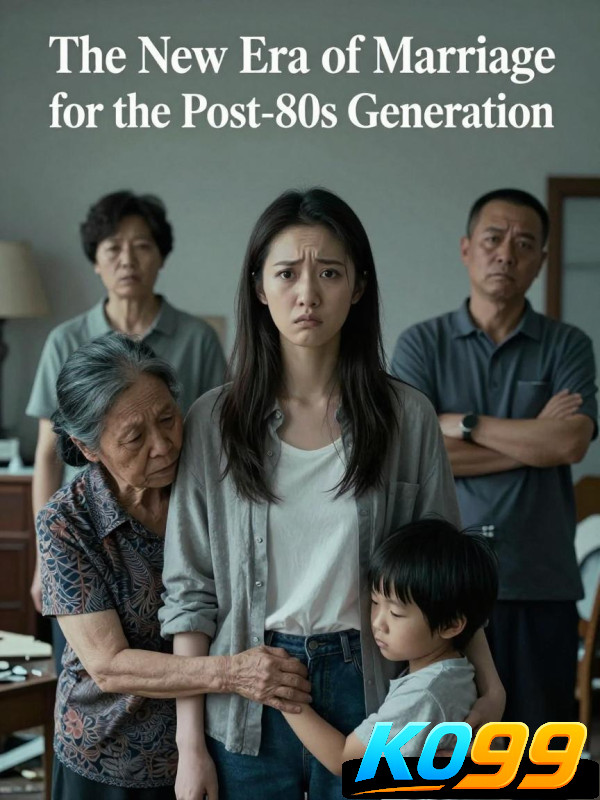
Her mother-in-law doted on the child and micromanaged everything, leaving Tong Jiaqian feeling helpless; her father-in-law and grandmother favored boys over girls, treating the child with cold words and a frosty demeanor, which also filled Tong Jiaqian with indignation. The challenges of raising a child, decisions about their savings, and how to handle their in-laws—all these issues came one after another…



Chapter 4: When the Head Is Crooked, the Neck Follows
Chapter 4: When the Head Is Crooked, the Neck Follows On my first day back at work, I stepped on the scale first thing in the morning. Even on an empty stomach, I was still a full fifteen pounds heavier than before I was pregnant. I slipped into my newly bought black slacks and black knit top, then stood in front of the mirror applying powder. Liu Yiyang eyed me from head to toe. “It’s your first day back in the workforce—why are you dressed so plainly?” “To look slimmer.” I replied succinctly. “You’re a mother now—how much slimmer can you get? You’re not exactly in high demand anymore.” Liu Yiyang slapped my butt, the loud thud a testament to how much I’d put on. I’m quick on my feet, so I slapped him right back: “They say mature women are all the rage these days.” Liu Yiyang grabbed my hand and pulled me into his arms: ““Jiaqian, you’re right. We’ll have it all. We’ll have everything. Trust me. Just give me time.” I squirmed in his arms: “I don’t want anything. I just want you to understand my heart.” After planting three quick kisses on Jinjin, I slipped on my new black leather shoes and headed out the door. It’s strange—when you gain weight, even your feet get bigger. In the past twenty-five years, when have I ever worn size 39 shoes? Six bottles of breast milk I’d saved up for Jinjin were neatly lined up in the fridge. My mother-in-law would feed them into Jinjin’s soft little tummy, and this would surely deepen the bond between grandmother and granddaughter. As for me, the “wet nurse,” I was practically turning into a milk-producing cow. Liu Yiyang’s “Greenfield Media” was located on the eastern side of Beijing—bustling and modern—while my workplace, “Shuoyuan Trading,” was on the western side, relatively quiet and residential. “Shuoyuan Trading” is a Taiwanese company that sells Taiwan-made home goods and handicrafts, with high prices being its most distinctive feature. As a copywriter, I’m responsible for drafting My boss, Tracy Fang—Fang is her Chinese surname, Tracy her English name—is in her mid-forties but insists on pretending to be in her twenties. She wears her hair straight and black, topped with a fringe cut as straight as a ruler. Her makeup is never garish; she favors only soft, pastel shades. Furthermore, while she requires us to wear business attire, she herself wears T-shirts and jeans every day. And regardless of whether it’s warm or cold, she always wears open-toed slippers indoors, with her toenails perpetually painted pink. According to Wei Guoning, don’t let Tracy’s flip-flops fool you—they may look ordinary and unassuming, but in reality, they’re just like our company’s products: two words—expensive. “I don’t buy it,” I protested. “Why is that?” Wei Guoning clasped his hands together in a gesture of admiration: “Because the brand is a royal brand from Taiwan—all the high-ranking officials and their families wear it.” Wei Guoning is my best friend at “Shuoyuan” and the sales manager there. He’s from a county in Tianjin, made it into college through the entrance exams, and stayed in Beijing after graduation. He’s nearly 1. 9 meters tall, weighs close to 190 pounds, has a wheat-colored complexion, thick eyebrows, and big eyes. I’ve told him before, “You look like you’d be great at farming.” Wei Guoning is down-to-earth to the core—he gives up his seat on the bus, turns in lost valuables to the police station, and even steps in to mediate when he happens upon a street altercation. In short, he possesses every one of those nearly extinct virtues. At the same time, Wei Guoning is quite slick when it comes to saving face. I’ve come to realize that perhaps, having only truly arrived in the city at the age of nineteen, he believes that if you aren’t slick, you’re not a city person. Wei Guoning is the same age as me. The reason I’m still just a copywriter at such a young age, while he’s already a supervisor, is because he and Tracy have a special relationship. There are about twenty people in the sales department, and roughly half of them are older and more experienced than Wei Guoning—which makes him the ideal candidate for this manager position. This inevitably meant that Wei Guoning’s days at “Shuoyuan” were not going to be easy. Today, one of them said, “A grown man making a living by selling his body—how shameless.” Tomorrow, another would say, “He’s the one telling me what to do? Doesn’t he ever stop to think about how he climbed to this position? He should just keep his head down and mind his own business—why does he have to act like such a go-getter?” All this talk, after all, was just empty gossip, because if they’d actually found even the slightest shred of evidence, “Shuoyuan” would have been in an uproar long ago. As for me—the one who’s kept quiet all this time—I’ve actually witnessed Wei Guoning and Tracy’s intimate moments firsthand. Back then, Liu Yiyang and I weren’t married yet. We’d been on a date that ran late into the night, and when I checked my bag, I realized I’d left my house keys at the office. To avoid disturbing my parents, who went to bed early, Liu Yiyang had no choice but to accompany me back to the office to get them. When we reached the office entrance, before I could even pull out my access card, I caught a glimpse of two figures moving inside through the glass doors. Just as I was about to shout, “Catch the thief!” Liu Yiyang covered my mouth and dragged me to the wall by the door: “Shh, that’s your boss.” I had complete confidence in Liu Yiyang’s eyesight; even though he’d only caught a glimpse of our boss from a distance a couple of times while driving me to and from work, I still trusted him. Upon hearing this, I hurriedly crept forward to get a better look—and just then, my eyes met Wei Guoning’s as he stood facing the entrance. Tracy, in Wei Guoning’s arms, had her back to me and was still writhing wildly, her body—though overly mature—still curvaceous. At that moment, Wei Guoning’s eyes were filled with embarrassment; a big man like him looked as flustered as a little white mouse. So I grabbed Liu Yiyang and we bolted away in the blink of an eye. It wasn’t until after that incident that Wei Guoning and I gradually became acquainted, though at the outset, neither of us had entirely pure motives. From my perspective, I hoped Wei Guoning would keep my appearance that night a secret from Tracy, so I could hold onto this hard-won job that aligned with my interests—lest Tracy view me as a ticking time bomb or a thorn in her side and have me fired. From Wei Guoning’s perspective, he naturally hoped I would keep quiet about that night’s “spectacular performance” between him—the new employee—and the old boss in front of his colleagues at “Shuoyuan,” to protect his personal reputation and his dignity as a man. And so, with an unspoken understanding between us, our relationship gradually evolved from stiff small talk into a simple friendship. As Liu Yiyang put it, “Two people who don’t talk much actually end up talking a lot when they’re together.” Later, Wei Guoning confessed to me, “That time you walked in on us—it was actually the first time.” Come to think of it, that makes sense. Every event in this world, every kind of person, and every relationship that forms requires the perfect alignment of time, place, and people. Just as I happened to forget my keys that day and happened to witness everything, Wei Guoning and Tracy must have also come together because of some such coincidence. And from then on, their ambiguous behavior shifted from “accidental” to “deliberate,” making it much easier to keep it under wraps. Liu Yiyang asked me more than once: ““Why would a young man in his prime, at twenty-five, get involved with a woman twice his age?” “It’s a long story—I can’t explain it to you in just a few words.” Being pregnant, I was either dealing with a lack of appetite or frequent urination and constipation; I really didn’t have the energy to explain someone else’s life to Liu Yiyang. “What’s so complicated about it? Isn’t it just about money?” Liu Yiyang concluded on his own. But in reality, while money is so powerful it can often make one’s head spin, it’s not the root cause of everything. “Xiaotong, how’s your recovery going?” Tracy sat cross-legged in her executive chair, elbows propped on the desk, hands cupping her cheeks, as she listened to my update. Every smile, every gesture of this woman seemed to make her appear younger. “Not bad—just need to lose a few pounds.” I spoke while sucking in my stomach. We were both women, both mothers, yet I was somehow curvier than this woman sitting before me, who was nearly twenty years my senior. Tracy also had a daughter, currently attending college in Taiwan. On her desk sat a photo of the two of them, dressed identically. Looking at that photo, I felt embarrassed for Tracy: How could she get so involved with a man barely older than her own daughter, right in front of her? She really had the nerve. “Not at all! In my opinion, your figure is just right—a woman looks best with a little meat on her bones.” Tracy spoke with such sincerity, which stood in stark contrast to her own bony frame. This boss is never stingy with words when complimenting her employees, but the moment a raise comes up, she’ll imply: “For this salary, I could hire someone a thousand or ten thousand times better than you. If you’re not satisfied, feel free to look for another job.” So, even though I’ve been with “Shuoyuan” for nearly two years, my salary has only gone up once—and the increase was so meager it once made Liu Yiyang burst out laughing. On my first day back at work, the workload was substantial, yet my mind was elsewhere. I could constantly hear Jinjin’s voice in my ears—her soft whimpers, her giggles, and her babbling—and whenever my thoughts turned to her, my breasts would fill with milk, causing an unbearable ache. “Shuoyuan” had just taken on a new consignment of ceramic works by local Taiwanese artists—hundreds of pieces, each unique yet similar in essence, priced between 8,000 and 120,000 RMB. As soon as I got my hands on the catalog, I went straight to Wei Guoning: “What do you think? Will these sell?” “Sell well? We haven’t sold a single piece yet.” Wei Guoning’s sales department was as bustling as it had been before I gave birth; every salesperson was clutching a phone, talking up a storm to whoever was on the other end. “Tong Jiaqian, this is all on you—go ahead and hype it up.” “I need a strategy to hype it up. Tell me, the mainland has such deep cultural roots and such a rich variety of art forms—it really has everything you could want. Who would buy a vase by an obscure modern Taiwanese artist?” I asked earnestly. “Tracy said the value of these vases lies in the fact that each one is one-of-a-kind.” “Unique equals expensive? Well, you can’t even find two identical leaves in this world.” I argued. “What can you do? You take their money to solve their problems—and we take their money to sell their goods.” Wei Guoning was right; we’re all just selling other people’s goods. Shuoyuan sells beauty-enhancing rice, so it’s twenty-six yuan a pound. The cups and plates Shuoyuan sells are designed to help the body absorb minerals, so each piece costs over a hundred yuan. The pillows and sheets Shuoyuan sells are meant to treat insomnia, so each set costs over a thousand yuan. So, will the ceramics Shuoyuan is selling today bring wealth and good fortune if I display them at home? I’ll have to think it over. I got home at six in the evening, my bag stuffed with the four bottles of breast milk I’d produced that day. As soon as I walked in the door, my mother-in-law rushed out to meet me: “Where’s the milk?” I froze: Could it be that I’m not the daughter-in-law of this household, but a milk delivery person? No, no—what I deliver is precious breast milk. Jinjin, swaddled tightly, was wailing in my mother-in-law’s arms, her little face flushed bright red. I snapped back to reality, my heart racing: “What’s wrong? What’s happened to her?” But my mother-in-law repeated the same question: “Where’s the milk? Hurry up and bring it out—the little one is hungry.” Hearing this, I didn’t even have time to take off my coat or shoes; I hurriedly opened my bag, pulled out a bottle, and presented the milky white breast milk. My mother-in-law hurried back to the room with Jinjin to warm the milk. I hurried to wash my hands and change my clothes, then washed the makeup and dust from my face. By the time I was ready, I rushed over to see my daughter—who felt like a lifetime away after just one day apart—only to catch her waving her chubby little arms, pushing away the bottle my mother-in-law was trying to feed her. She was still crying, desperately, crying her heart out. My mother-in-law’s eyes welled up with tears: ““Little one, what’s wrong? Won’t you even drink fresh milk?” I rushed over: “Mom, what’s going on?” My mother-in-law was still trying to slip the nipple into Jinjin’s mouth: “I don’t know either. She was eating just fine this morning, but by the third feeding, she refused to take a single sip.” Jinjin shook her head from side to side, her little mouth twisted into a heart-wrenching grimace. “What? So she’s been hungry all afternoon?” For the first time in my life, I felt a heart-wrenching pain. “Not exactly. She’d take a bite when she was starving, then refuse to eat again, crying her eyes out.” My mother-in-law seemed just as distressed as I was. “Then why didn’t you call me? Why didn’t you take her to the hospital?” “Well, I saw that she seemed fine—her forehead wasn’t hot, and she wasn’t having diarrhea or vomiting.” “Jinjin, Jinjin, what’s wrong, Jinjin? Tell Mommy, where does it hurt?” I grabbed Jinjin’s flailing little hand; it was ice-cold and damp with sweat. Suddenly, Jinjin stopped crying. She turned her head and looked at me. Her tear-filled eyes were so heartbreakingly beautiful, so pitiful, as lovely and precious as black pearls soaked in seawater. Then she opened her little mouth slightly and stretched out her arms, as if asking for a hug. “Mom, give her to me.” I snatched Jinjin from her and unbuttoned my shirt. Jinjin buried herself in my arms, quickly and precisely latching onto my nipple and suckling greedily. Before her tears had even dried, a smile spread across her lips. Her tiny hands clutched my breast tightly, as if holding onto the most important thing in her life. This little one truly was the best embodiment of the saying, “Food is the foundation of life.” “It seems our little one isn’t used to having a bottle for every feeding,” my mother-in-law said, clutching the bottle as a realization dawned on her. Though her expression darkened slightly because Jinjin had chosen me, she was mostly relieved to see Jinjin so content. Jinjin, who had always been breastfed, would occasionally drink water from a bottle or drink the milk I’d prepared in advance when I wasn’t around. But today was the first time she’d gone so long without latching onto my breast. In her simple mind, perhaps she thought that the woman who had always provided her with nourishment—the woman whose entire body was imbued with the scent of the milk she cherished so dearly, the woman who would gaze at her with such fascination the moment she saw her—had abandoned her. I was enveloped by a feeling of contentment. I am Jinjin’s mother, the person closest to her; this is a fact that no one, under any circumstances, can change. Having eaten her fill, Jinjin fell straight into a deep sleep from sheer exhaustion. I leaned down and rubbed my nose against her smooth little cheek, but she didn’t stir. I placed her in her crib—a bed that gets used less often than my mother-in-law’s embrace—and only then did I think to ask, “Where are Dad and Grandma?” “They found it too noisy and went out,” my mother-in-law replied, standing by Jinjin’s crib and watching her through the rails. Under this same roof, for this very same little life, there existed two such diametrically opposed feelings. I, Liu Yiyang, and my mother-in-law all loved Jinjin with our whole hearts—a love so deep we were willing to sacrifice ourselves, a love so intense we wanted to possess her; yet my father-in-law and Liu Yiyang’s grandmother seemed to regard her as nothing more than a stranger. A daughter—what’s wrong with a daughter? Is she missing an arm or a leg compared to a son? Or has she lost her heart and lungs? Indeed, compared to my mother-in-law’s possessiveness toward Jinjin, I truly loathe those two heartless mindsets even more. Grandma was the first to return, her jowls nearly sagging down to her shoulders: “That Grandma Li in Building 6 had a pair of grandsons—twins, both weighing over five pounds.” Hearing this, I looked at Grandma and immediately thought she resembled a rabbit with bloodshot eyes. These days, every family strives to keep their dirty laundry at home while spreading good news far and wide—why must you envy others? When these little darlings reach marriageable age, go see whose life is easier then. Two boys? When it comes time to marry them off, won’t you have to prepare two apartments? And if they don’t amount to much themselves, won’t they still have to rely on their elders to sell everything they own? We’ve been talking about gender equality for years, but if it’s ever truly realized, I have no idea how many more generations we’ll have to endure. At least in our generation, it still seems like the groom’s family is supposed to provide the wedding home. By the time Jinjin and those twins—who together weigh just over ten pounds—reach marriageable age in twenty years, I don’t believe this “custom” will have changed much. Starting today, I’ll start wishing that Grandma Li’s grandsons will be as lucky as Liu Yiyang in the future—that they’ll find extraordinary women like me, Tong Jiaqian, who don’t prioritize material wealth but seek spiritual fulfillment, so they won’t end up exhausted from the stress of buying a house and marrying a wife. My father-in-law was the second to return, looking full of energy. I couldn’t tell if the rosy flush on his face was from the wind outside or the joy bubbling up from within. When he saw me opening the door for him, he actually smiled—a rare occurrence: “Jiaqian, off work? Are you tired?” I shook my head blankly: “No, not tired.” The world is vast and full of surprises—my father-in-law was actually showing concern for me. And I was such a weakling; just that offhand greeting he let slip nearly brought tears to my eyes. Human nature really is something else—I have plenty of people who love me, asking every day if I’ve eaten enough, if I’m warm enough, and if life is going well. I just take it for granted and never feel the slightest bit of gratitude. Yet here I am—the very person he usually gives the cold shoulder to—and the moment he offers me even a sliver of warmth, I glow with such radiance I could light up the room. “Jinjin, you’re not crying anymore? Good girl.” My father-in-law took off his shoes and hat, then slipped out of his down jacket before stepping into the room. My mother-in-law, who was in the room, froze in surprise: When had this old man ever shown such tenderness toward his granddaughter? Could it be that he’d just gone out to receive some “education” from the motherland and the Party? Had he finally realized that women can hold up half the sky too? Just then, my father-in-law’s down jacket clattered to the floor from the coat hook. As I picked it up and hung it back, I realized exactly where he’d been. Sticking out prominently from the shoulder of that earth-colored down jacket was a long, curly strand of black hair. In this household, Grandma’s hair is white, my mother-in-law’s is short, and mine is straight—and as for Liu Yiyang and Jinjin, they certainly couldn’t be the source. In fact, I didn’t even need to rule out any of us; I knew right away that this strand of hair belonged to the woman in the dark green overcoat. That woman had a head of romantic, wavy black hair. I slipped silently into the kitchen. I, Tong Jiaqian, am no naive girl; a single strand of hair is really no big deal. Liu Yiyang was the last to get home, looking disheveled and exhausted, with every exposed part of his body frozen stiff. I gave him the usual lecture: “You really shouldn’t ride that motorcycle.” “Oh, uh-huh.” Liu Yiyang sidestepped into the bathroom and shut the door. I followed him to the door and knocked. “Stomachache?” “Mm-hmm.” Liu Yiyang seemed disinterested in talking to me, completely absorbed in the toilet. I scurried back to my room and fetched a bottle of berberine. When Liu Yiyang finally emerged from the bathroom, reluctantly, my eyes widened. On the shoulder of his khaki sweater, there was a strand of long hair—auburn, strikingly conspicuous. As far as I could tell, no one in this household, long or short-haired, had a single auburn hair on their head. I walked step by step toward Liu Yiyang, reached out, plucked that glaring piece of evidence from his shoulder, then sidestepped him and squeezed into the bathroom. I tossed the evidence into the toilet, flushed it down, and destroyed it. Breathing in the fresh air around me, I couldn’t help but feel that the bottle of berberine in my hand was particularly ironic. Liu Yiyang was dumbfounded, watching my series of actions, completely dumbfounded. “What? You spent ages checking in the bathroom just now, and you didn’t expect there’d still be something you missed?” I slipped the berberine into my pocket and began washing my hands thoroughly. God only knows how many bacteria were clinging to that reddish-brown hair. “Checking what?” Liu Yiyang chuckled, making a last-ditch effort to save face. “Lipstick marks, perfume scent, a strand of hair… and so on.” I maintained my composure, smiling faintly. The reason I was helping Liu Yiyang destroy the evidence was simply that people need to save face—I didn’t want anyone else in this household to see that hair, nor did I want to get into a physical fight with Liu Yiyang in public. “Jiaqian, let me explain.” Liu Yiyang finally saw the writing on the wall and chose the path of confession for leniency. “No, I have eyes of my own. I don’t need to hear your bullshit explanations.” Composure isn’t always easy to maintain. A long strand of hair on my father-in-law’s body isn’t a big deal, but if that same strand were on my husband’s body, that would be a whole different story. As the saying goes, like father, like son. During dinner, Grandma looked at me as if she wanted to say something but held back. After a long pause, she finally managed to say, “Jiaqian, are you upset?” As they say, experience counts for a lot. No matter how hard I tried to put on a show, I couldn’t fool her sharp eyes. “No,” I denied, then went out of my way to add, “I’m actually very happy.” But Grandma didn’t seem to care much about that. She didn’t press the issue and immediately changed the subject: “Jiaqian, do you and Yangyang want to have a second child?” A mouthful of rice got stuck in my throat: A second child? That word doesn’t seem to exist in my personal dictionary. Jinjin has already captured all my maternal love; I will devote my entire life to nurturing her, the most beautiful flower in the world. A second child? No, thank you. Besides, having just one child has already lowered Liu Yiyang’s and my standard of living. To buy Jinjin the driest diapers, we can’t afford to eat out;to buy Jinjin the purest cotton clothes, the highest-quality daily necessities, and the most educational toys, we take the bus whenever possible instead of the subway, and the subway instead of a taxi; to ensure Jinjin can attend the most prestigious kindergarten in the future, we’ve agreed to buy only one new item of clothing each per season—and it has to be off-season clearance. At this point, why am I even thinking about all this? Jinjin’s father has already cheated on me—he’s been unfaithful. How could he possibly work with me to build a bright future for Jinjin? “We don’t have any plans for that right now,” I said, speaking my mind. “Liu Yiyang and I don’t own a single square foot of property. We’re already living here with Dad, dragging Jinjin along with us. If we have another child, I don’t even know where we’d put them.” “Put them in my room—it’s spacious.” Grandma replied without hesitation. “Does that mean you’ll take them in your room no matter if it’s a boy or a girl?” I cut straight to the chase. This time, the old lady hesitated. She wanted to shake her head, but felt it wasn’t quite appropriate; she wanted to nod, but wasn’t entirely sure. So she just froze there, letting the hot soup in front of her cool down bit by bit. I really loaded this soup with plenty of dried shrimp today. Grandma exited the scene, and Grandpa took the stage, his earlier kindness vanishing without a trace: “We won’t have room if we have another one? Are you saying my house is too small? Really, it’s like a small temple can’t hold a great Buddha.” “Dad, do you want a second grandchild too? Then I’ll ask you the same question. If the second one is a girl too, will your little temple still have room for me?” Today has truly been a day of extreme highs and lows. Jinjin’s longing for me—even if it was just for my breasts—and my father-in-law’s “favor,” all vanished in an instant under the Liu family’s obsession with male heirs. And that damned long, reddish-brown hair—damn Liu Yiyang. “Dad, don’t listen to her. She’s just complaining that I don’t have enough money to buy a house. As a junior in the family, how dare she complain about you?” If Liu Yiyang had chosen his words more carefully, he could have played the role of peacemaker. Unfortunately, he seemed to be seething with anger himself, and every word he spoke was laced with hostility. What gives him the right to be so angry? After cheating on me, he didn’t even bother to wipe his mouth clean—and he has the nerve to be angry? “Liu Yiyang, you’re only half-right. Yes, I’m disappointed in you—disappointed that you’re incapable of supporting a wife and children, let alone taking care of your parents in the future. But I’m also disappointed in the rest of this family. As for what exactly I’m disappointed about, we both know it in our hearts.” ” With that, I set down my chopsticks and headed toward that cold, gloomy room. Unfortunately, before my hand could even touch the doorknob, Jinjin’s cries began. My feet felt as if they’d taken root; I couldn’t move an inch. I, Tong Jiaqian, am no longer a little girl who can act on a whim, nor am I a free spirit without responsibilities or burdens. I am a mother now; I have Jinjin. So even if I’m so furious I feel like I’m about to explode, so heartbroken I can barely breathe, and so desperate to leave this house just to get some fresh air—the moment my daughter needs me, I can no longer live for myself. So I had no choice but to change course and go comfort my daughter. My head felt heavy, my neck limp. Just moments ago I was raging, complaining about this and that, yet now I had to borrow my father-in-law’s room to hold Jinjin—the child I could never let go of. The atmosphere at home was so cold it felt like it could freeze over. Grandma closed the door, and the room fell into a quiet, pitch-black silence. My father-in-law slipped out the door without a word. I wonder if the wind outside is strong enough to blow that long strand of hair off his head. If not, I’d actually hope it falls into my mother-in-law’s hands—I’d love to see how a woman of her age would handle such a thorny situation. In this household, my mother-in-law’s status is probably only above mine and Jinjin’s. So, regarding that earlier argument—which perhaps didn’t even qualify as a real argument—she couldn’t really say anything to anyone. Especially since, at the moment, only she and I are wholeheartedly and with all our strength raising Jinjin. This has, to some extent, fostered a sense of camaraderie between us. As for Liu Yiyang, after cleaning up the leftovers, he came over to where Jinjin and I were sitting. His face was cold, but as his large hand gently rubbed Jinjin’s small one, a paternal love he couldn’t contain began to show. I glared at him, but he stubbornly refused to meet my gaze, as if to say, “This is who I am—what are you going to do about it?” So, for the first time in my life, I took the initiative to hand Jinjin over to my mother-in-law, then grabbed Liu Yiyang’s sleeve: “Come on, let’s go back to the room.” Liu Yiyang shook my hand off as if I were a speck of dust, still saying nothing. I felt utterly humiliated: this is what it means to live under someone else’s roof. Arguing with your husband—and having to do it right in front of his mother—leaves no room for dignity, regardless of who wins or loses. But this time, my mother-in-law broke with her usual pattern. Instead of defending her precious son, she took my side: “Yangyang, if you have something to say, go back to the room with Jiaqian and talk it out. If you two keep arguing here, how is Little Bao supposed to sleep?” My mother-in-law had clearly become an ally of mine, because in her eyes, “Little Bao” was an extension of “Yangyang,” a sublimation of him. “Yangyang” had long since spread his wings and become independent, no longer lingering in her embrace. But now, “Little Bao” had been born, inheriting her endless, ever-renewing maternal love. For Jinjin’s sake, Liu Yiyang followed me back to our room. I shut the door tightly, though I knew full well that once things got out of hand, no wooden door could possibly contain the volume of our voices. “What right do you have to give me the cold shoulder?” I struck first. “Then what right do you have to talk back to Grandma and Dad?” Unable to answer my question, Liu Yiyang turned the tables on me. But I had an answer: “Because they really do favor boys over girls, and they really are being unfair to Jinjin.” “I know that,” Liu Yiyang’s tone took on a note of resignation. “But this isn’t the first time you’ve known it. It’s wrong of them to favor boys over girls, but does that make it okay for you to act so disrespectfully? We’ve been living together for a year, and Jinjin has been here for three months—why can’t you handle it all of a sudden today?” “Suddenly? Let me tell you, Liu Yiyang, it’s not me who’s acting suddenly today—it’s you. Don’t try to act like nothing’s wrong. Do you think that just because your dad and grandma got involved, you can take advantage of the chaos and get away with it?” “What am I getting away with? Let’s keep things separate. I think you’re the one mixing everything up. If you have a problem with me, take it out on me—there’s no need to take it out on my grandma and dad.” “Is there a difference? You’re both just following in each other’s footsteps.” How convenient—today, both father and son have found themselves in romantic entanglements. “Tong Jiaqian, don’t let your words get out of hand.” Liu Yiyang’s voice suddenly rose. From that moment on, my earlier attempt to close the door became completely pointless. “All you found was a single hair on me. What do you think that means? That I’m seeing someone else? Save your imagination. If I were that kind of person, would I have waited until today? We’ve been together for seven years, we even have a child—and this is how much you trust me?” “So what if we’ve been together for seven years? So what if we have a child? It’s common for men’s consciences to be overpowered by their lower halves.” In the end, I had become a neurotic, desperate wife, completely losing my composure. “Since you’re so quick to jump to conclusions, I’ve got nothing more to say.” With that, Liu Yiyang turned on his computer, ready to kick off the cold war. But I stepped forward and flipped the switch on the power strip: “I’ll give you one chance. Speak up.” I wanted to give Liu Yiyang a way out—and I wanted one for myself even more. I, Tong Jiaqian, am a straightforward, hot-tempered person who can’t stand Liu Yiyang’s sluggishness. A cold war—a tactic the enemy excels at while we suffer through it—I’d rather not let it start at all. “Listen carefully: I haven’t done anything to wrong you or our daughter.” Liu Yiyang stared at the pitch-black computer screen as if he could stare a hole right through it. “Don’t be so vague. Tell me about that strand of hair. Tell me why you bolt straight to the bathroom the moment you get home.” Now that the conversation had started, I might as well get to the bottom of it—otherwise, clinging to some illusory sense of pride and face would only trap me in endless fabrications and speculation down the road. “That must have been Sun Xiaorou’s hair. Actually, I’m not entirely sure.” “Not sure? Are there maybe a second or third candidate?” “Will you ever stop? Do I look that pathetic to you?” “Then just spit it all out at once. I’m not in the mood to be kept hanging.” “Just before we left work today, Sun Xiaorou was in a bad mood and started crying. I tried to comfort her, and she… she leaned against me. That’s probably when the hair got stuck on me.” Liu Yiyang’s words were a bit stammering, but I attributed that to the awkwardness and shyness he felt from having physical contact with another woman, rather than to him making up a lie. “Why was she in a bad mood?” I intended to get to the root of the matter. “In their circle, it’s tough for newcomers. Being bullied and pushed around is common. Only those who endure it have a chance at stardom; the thousands who don’t just fade into obscurity and go back to being ordinary people.” “Why are you telling me all this? Go tell her. If she wants to make a name for herself, she needs to tough it out—not break down crying at the drop of a hat.” “Exactly, that’s what I told her. But she got all emotional and ended up screwing me over.” “Is that all there is to it?” “How complicated do you think it is? Don’t you realize I don’t have the energy to deal with other women? You alone cause enough trouble every day—I can barely keep up.” “Then why doesn’t she go cry to someone else instead of you?” I’ll let Liu Yiyang’s remark about me “causing trouble” slide for now. I need to figure out the ins and outs of that “external threat,” Sun Xiaoyao, before I can deal with this “internal troublemaker,” Liu Yiyang, and his reckless behavior. “Well, she had to find someone anyway. It’s just a matter of luck that she happened to pick me. Why couldn’t she have come to me? Besides, I’m a decent guy—honest, straightforward, and I make friends easily.” That was Liu Yiyang’s good-natured way. No matter how angry he was with me at first—even if he was fuming—after a few rounds of “discussion” with me, his anger would naturally fade away. “Fine, I believe you. But I’m warning you: don’t go making female friends from now on. That Sun Xiaorou looks like a little devil. I’m telling you straight up—if she wants to play games with you, she’ll get you every time.” “Tong Jiaqian, aren’t you just boosting her confidence and undermining your own?” “Come on, I’m not undermining my own confidence—I’m undermining yours. I’m being serious here. Most people know to keep a safe distance from a married man to avoid getting into trouble. Sun Xiaoyao doesn’t seem like someone who doesn’t know better; she seems to be doing it on purpose.” “Fine, if need be, I’ll be the one to maintain that distance. Anyway, I just treat her like a kid—I don’t see her as a woman at all.” I believed what Liu Yiyang said. That word “be a good girl” he’d said to Sun Xiaoyao over the phone back then had now become irrefutable proof. Actually, when I calmed down and thought it through, it wasn’t hard to see: Liu Yiyang had never once told me—as a “woman”—to “be a good girl.” Instead, he’d nag at “little girl” Jinjin every day: “Be a good girl, drink lots of milk today, and put on some weight, okay?” “Be a good girl, don’t make Mom and Grandma work too hard.” “Be a good girl, come here, let Daddy give you a kiss.” So perhaps Liu Yiyang really did treat Sun Xiaorou—who was only four years younger than him—as if she were in Jinjin’s age group. After all, in this day and age, age doesn’t mean a thing. Isn’t that true of Wei Guoning and Tracy, who are right here with me? “Then… then why did you bolt straight to the bathroom as soon as you got back?” “I—I was really nervous. Before facing you, I had to calm myself down a bit, didn’t I?” “You’re really something.” “Alright, I’ve made my case. So isn’t it your turn to apologize now?” Liu Yiyang’s presence immediately grew more commanding. “Apologize for what?” I’m not the kind of person who crumbles just because the other side is strong. “What do you mean, ‘the apple doesn’t fall far from the tree’? Isn’t that a bit harsh?” Liu Yiyang’s respect for his elders was undoubtedly a time-honored Chinese virtue. He treated my sharp-tongued mother with the grace of a gentleman, let alone his own flesh and blood. “I didn’t say anything wrong. If one day you really do something scandalous, it’ll definitely be inherited from your father.” By the time I finished that sentence, my hand had already reached for the doorknob—I couldn’t wait to get back to my Jinjin before my father-in-law returned. But as it turned out, he came home right then. The moment I opened the door, I ran right into my father-in-law, who had just stepped inside and was taking off his shoes in the entryway. We were neither too close nor too far apart, so I couldn’t be sure if he’d heard my “inheritance theory.” He stared at me coldly, and I couldn’t tell if it was because of our previous conflict, my rude remark just now, or simply my own guilty conscience playing tricks on me. “Dad, you’re back.” After politely acknowledging him, I retreated to my room. Jinjin, it’s enough that you’re the only one in this house causing trouble right under the owner’s nose; Mom really can’t afford to give anyone else a reason to be annoyed. As for the matter involving my father-in-law and that woman in the dark green coat, I’ve never mentioned it to Liu Yiyang. First, because they were always hanging around the house, which made it impossible for me to speculate that their relationship was anything but proper—even though their closeness seemed obvious. Second, because it’s better to mind your own business. Whether it’s true or false, beautiful or ugly, or just a misunderstanding, I don’t think Liu Yiyang would want me, his daughter-in-law, to be the one to bring it up.