
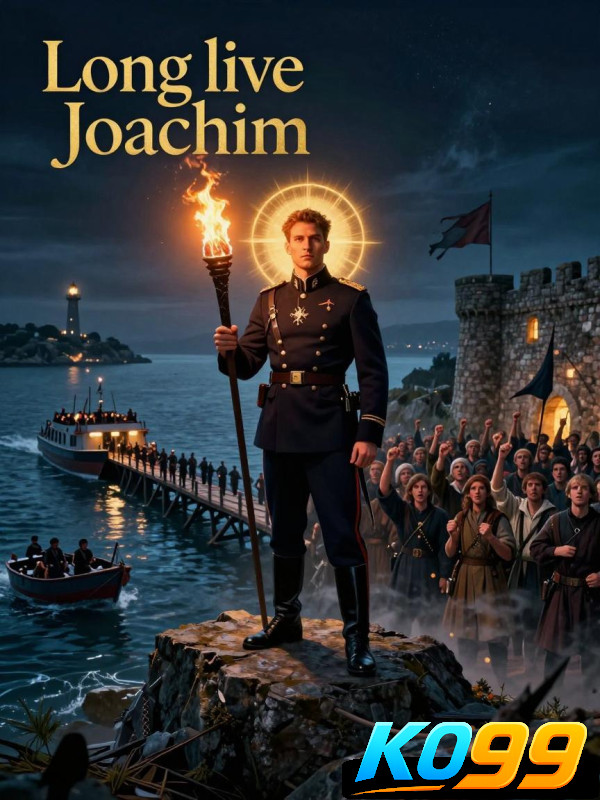
He traveled back in time to Germany over a century ago, where he carved out a place for himself through wisdom, insight, diligence, and perseverance. He pioneered amphibious landing tactics and conquered small European island nations; with extraordinary courage and determination, he climbed step by step to the pinnacle of his life. Crowned with the sacred aura of a savior, he listened to the cheers of the masses: “Long live Joachim!”



Chapter 10: General Situation
Chapter 3: General Situation The majestic and majestic chorus of ten thousand people still echoes in my heart, and the previous "Hohenfliederberg March" has been played again. Both the guests of honor on the viewing platform and the onlookers on the outer circle are standing to watch the upcoming military parade. The German Royal Guard was the first to pass through the viewing platform, with their agile steps, orderly formation, and majestic momentum, just like the shock and awe brought by the British Navy. Following closely behind is the German Royal Military Band, whose musicians hold instruments of varying sizes and have relatively large intervals between them. However, each person maintains precise consistency in their stride and speed. On the speedboat next to the Royal yacht "Hohenzollern", Xia Shu has recovered from the passionate emotions of the entire chorus just now, and he calmly looks at the procession on the dock. The German soldiers in sight are marked by pointed steel helmets and navy round hats. They hold their heads high and walk briskly in the German goose step - this "upright step" with a straight upper body and powerful leg movements originated from a European dance. It was first adopted by Frederick the Great in Prussian military parades in the 18th century. Due to the elite quality of the Prussian army, this step was gradually learned and promoted by some countries. Since it is Military Port Day, the navy naturally becomes the protagonist of the parade. More than two thousand naval infantry arrived in six formations, some from base defense units and some from naval and marine units (combat infantry specially equipped on battleships and cruisers). The neat formation, neat attire, and full spirit all demonstrate the good qualities of German naval officers and soldiers. During the land parade, two Zeppelin airships also took advantage of the calm weather to come and cheer. The earliest airships can be traced back over a hundred years, and the groundbreaking Zeppelin airship was invented by the famous Count Ferdinand von Zeppelin in 1900. German military strategists immediately recognized its enormous potential, and Count Zeppelin, a retired German soldier, used this invention for the German army. Nowadays, the Zeppelin airship has a quite large appearance, and many people feel as if they are locked in a spell at first sight, overwhelmed by its magnificence and wonder. Compared to those round hot air balloons, these airships proudly dominate the sky like dinosaurs, and their appearance is always accompanied by the unique roar of high-powered engines - although Daimler's new gasoline engine has shortcomings such as high cost and short lifespan, it still received considerable orders from Zeppelin airship company and Royal Shipyard. The former is owned by the Count of Zeppelin and is the sole manufacturer of Zeppelin airships, while the latter is a German royal industry that was once on the brink of bankruptcy but has now successfully transformed into a leader in the fields of racing rowing and torpedo boat manufacturing. Its manager is none other than the young genius of the Hohenzollern family, German Prince Joachim! The traditional land military parade has ended, and the highlight of the Military Port Festival is still ahead. Amidst the passionate sound of military music, German Emperor Wilhelm II, with his upturned beard, walked past the gun wielding naval honor guard in naval attire. Following closely behind were the Crown Prince Wilhelm and two key figures in the current German Navy: the German Emperor's brother, Admiral Heinrich, and the founder of the German Navy, Count von Tirpitz, the Navy Secretary of State and Prussian Navy Minister. When the first four climbed onto the pier, Joachim, standing on the speedboat, had already put on a round naval hat with a flat top and short brim (traditional boat shaped naval hats require formal attire). This 14-year-old royal youth is currently not an official member of the German Navy. He has just entered the Kiel Naval Academy for initial training, and typically, after three and a half years of rigorous training, students can join the German Navy as probationary lieutenants. Joachim's older brother, Adalbert, the third son of German Emperor Wilhelm II, is currently studying at this renowned naval academy. He has completed all the theoretical courses and will be able to graduate after several months of training on a training ship. Unlike her elder brother's political considerations for choosing the navy, Xia Shu entered the navy with both a strong personal will and the deep hopes of German Emperor Wilhelm II. William II, with his rebellious personality, greatly admired his maternal grandmother, Queen Victoria of England, and envied the dominance of the British fleet that roamed the seas. He was deeply influenced by Mahan's ideas on sea control and believed that only by expanding overseas could he become one of the world's great powers. After donning the German crown, William II's growing national strength made him even more eager to have an invincible naval fleet. He himself had a strong interest in warships, but unfortunately, ship design was a rather complex subject that required William II to oversee the entire empire. He had to entrust the task of building a first-class fleet to more professional people, namely his "eternal Tirpitz". The naval minister who shares the same interests as the German emperor is undoubtedly a trustworthy person, but until time tests everything, no one can guarantee that he has created a top-level competitive fleet - Germany's geopolitical environment determines that it must always prioritize the development of the army, and the resources invested in naval construction cannot be endless, making the quality of ships particularly important. Germans are skilled in machinery, and the flourishing development of the shipbuilding industry has also given them a group of outstanding ship engineers, which is the capital for the German Navy to achieve its dream of the ocean. With ordinary thinking, excellent engineers can ensure quality, while talented engineers can bring about technological leaps. At the age of 5, he assembled a wooden warship model, at the age of 7, he made a sophisticated electric ship model, at the age of 9, he corrected a drawing error made by a professional designer, and at the age of 11, he designed a high-performance speedboat. Such geniuses were born in the German royal family - for Xia Shu, who had been working in the modern shipbuilding field for many years, these were just casual appetizers, but in the eyes of German Emperor Wilhelm II and his follower Tirpitz, they were priceless treasures bestowed upon the German Navy by heaven! Encouraged by the imperial leadership, the young Prince Joachim became a frequent visitor to the German Navy, frequently visiting the offices and databases of shipbuilding evaluation experts, and even following Tirpitz to visit major shipyards in Germany. The fact quickly proved that the praise for the young genius was not in vain. At the suggestion of Prince Joachim, the Germania shipyard made important design improvements to the 1898 torpedo boats, and the subsequent 25 ships had significantly improved navigation performance compared to the 30 ships completed earlier. Afterwards, the motorboat designed by Prince Joachim won the championship of the 1903 Bremen Cup water race, and later won the small torpedo boat bidding case from the Navy Department. Before 1908, the Royal Shipyard he managed would provide the German Navy with 180 "Thunderbolt" speedboats for offshore operations, with a total contract price of 19. 8 million marks. In this situation, not only Emperor Wilhelm II of Germany, but also all the officials of Tirpitz and the Navy eagerly hoped that this royal genius could join the German Navy - when Joachim's growing body was strong enough, they finally achieved their wish! Wilhelm II and his entourage boarded the "Hohenzollern" directly, and the German Emperor's flag with black eagles, crowns, and iron crosses as the main patterns was immediately raised on the yacht. The clear sound of the whistle announced the beginning of the naval parade. After the royal yacht was launched, Xia Shu drove his speedboat closely behind the side, creating a scene that looked like a galloping horse and a sheepdog walking together. When they arrived at the center of the harbor, the other seven "Thunderbolt" speedboats and four 1895 torpedo boats waiting there steadily joined in, closely guarding the "Hohenzollern" like royal sword guards. The particularly neat sea formation also became a beautiful scenery. Wherever the royal yacht went, each ship fired salutes, but not everyone was filled with respect for this powerful military empire and its rulers. In recent years, Germany has shown increasingly strong expansionism in diplomacy, politics, colonial affairs, and other areas. It has also acted arrogantly on some sensitive issues. During the Bismarck era, the Russian regime, which was close to and dependent on Germany, turned to ally with the French. Britain, which has always pursued a "continental balance" and "freedom policy", also formed a defense alliance with France. While material wealth grew rapidly, Germany's situation became increasingly isolated, and its only two allies, Austria Hungary and Italy, one was on the brink of decline and unable to take care of themselves, while the other was indecisive and unable to provide truly reliable strategic support. Instead, they repeatedly dragged Germany into the quagmire of regional disputes PS:1、Due to the fact that the Second German Empire belonged to the Commonwealth of States under a constitutional monarchy, there was only one minister, the Prime Minister, at the political level of the empire. The heads of various domestic and foreign departments were called State Secretaries. For example, Tirpitz's official position was State Secretary of the Imperial Navy and Minister of the Navy of the Kingdom of Prussia. 2. Under the gold standard system in the late 19th and early 20th centuries, the gold content of each country's currency was as follows: 1 pound=7. 32238 grams of gold 1 franc=0. 2903225 grams of gold 1 USD=1. 50463 grams of gold 1 German Jinmark=10 German Marks=3. 58425 grams of gold 1 ruble=0. 774234 grams of gold 1 yen=0. 75 grams of gold The exchange rates of various countries are directly calculated based on the gold content, and the following ratios can be used for rough estimation: 1 pound=25 francs=5 US dollars=2 German ringgit=20 German marks=9 rubles=10 Japanese yen