
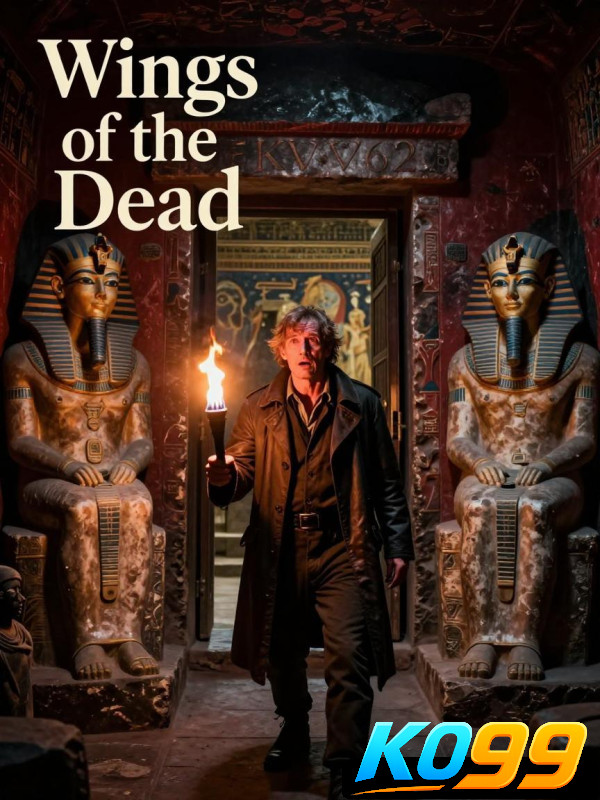
Howard Carter’s footsteps echoed faintly through the dim, narrow tomb passage. The 64-year-old archaeologist gazed at the light cast by his torch, his eyes unfocused and filled with fear. In the glow, shrouded by darkness, stood a half-open stone door, flanked by seated statues of the pharaoh and the queen, their narrow eyes gazing silently ahead.


Chapter 1: Prologue
Prologue On the west bank of the Nile, in the mountains south of the ancient city of Khena, lies the Valley of the Kings. Howard Carter’s footsteps echoed faintly through the dim, narrow tomb passage. The 64-year-old archaeologist gazed at the light cast by his torch, his eyes unfocused and filled with fear. In the glow shrouded by darkness stood a half-open stone door, flanked by seated statues of the pharaoh and his queen, their narrow eyes gazing silently ahead. Tomb KV62. The place that embodied both the culmination of Carter’s life’s work and his worst nightmares. Howard Carter was a world-renowned British archaeologist. On November 5, 1922—sixteen years ago today—the archaeological team he led unearthed Tutankhamun’s tomb in Egypt’s Valley of the Kings. Dating back over 3,300 years, the tomb contained more than 5,000 burial artifacts, including gold, ivory, and wood carvings. The Times published an editorial hailing it as “the greatest treasure ever unearthed by modern man.” Yet no one could have anticipated that this tomb would bring Carter’s team not a flood of wealth and fame, but a series of mysterious calamities. On November 5, 1922, the day the tomb was unearthed, the expedition’s patron, Lord Carnarvon, was the first to step into the pharaoh’s main burial chamber, accompanied by the entire archaeological team except for Carter. Carter himself did not enter the main burial chamber until November 6, for a simple reason: November 6 happened to be Pharaoh Tutankhamun’s coronation day, making the occasion all the more significant. Before long, a bizarre tragedy unfolded—the first victim was Lord Carnarvon. He developed a mysterious, persistent fever and was admitted to a hospital in Cairo, where he died in his bed on the third day. His only last words were: “The pharaoh has called my soul away.” A month after Canavon’s death, Professor Richard—the team physician and the one responsible for dissecting the pharaoh’s mummy—had been back in England for less than half a day when he inexplicably returned to Cairo, walked alone into the great desert, and never came back. Over the next six months—the latter half of 1923—key members of the team, including Moses and Vansel, also died under mysterious circumstances, most of them ruled to have committed suicide due to “schizophrenia.” Yet there was one person in the expedition who did not die: Carter himself. However, he was haunted by a recurring nightmare in which a figure told him, “Your canary will die in your place.” As it turned out, on Christmas Eve 1922, his daughter Evelin Carter hanged herself in the attic, leaving behind a single line in her suicide note: “I can no longer bear the pharaoh’s torment.” Carter recalled these painful memories as he unconsciously made his way to the entrance of the main burial chamber—the stone door he had chiseled open with his own hands sixteen years earlier. He gazed at the hieroglyphs on the door; they seemed like pairs of eyes hidden in the darkness, staring at Carter with an eerie expression, causing his hands to tremble violently. Anubis, messenger of Osiris, shall cast the curse of the wings of the dead upon those who disturb the Pharaoh’s rest. Today, in the eyes of the world, these hieroglyphs are the root of all tragedy—the pharaoh’s eerie curse upon tomb raiders. From the very beginning, Carter could not tolerate this notion; he believed it was a disservice to science and, more importantly, an insult to the dead. To comfort the spirits of his daughter and friends in the afterlife, Carter vowed to unravel the mystery of the curse. He firmly believed that the curse was not a supernatural phenomenon; there must be a rational explanation for it. To find this explanation, Carter spent his entire fortune and devoted three years to research, conducting every possible study and investigation within his power, yet he found nothing. During this time, many things happened: he was mocked by the public, insulted by the media, and even dismissed by the Royal Society of Great Britain. Yet he never gave up, saying that his daughter and dear friend were watching over him from heaven. In a stroke of luck amidst his misfortune, the following spring, Carter was hired by a research institute in Czechoslovakia. Although he could not study the artifacts directly, his research was finally able to continue. What happened next was something even Carter himself had not anticipated. It was during this time that an unexpected turning point emerged. What provided Carter with this turning point was not any data, literature, or the works of archaeological luminaries, but rather these eerie hieroglyphs before his eyes—Tutankhamun’s “curse.” In fact, it was not a curse, but a hint—a hidden hint. The method used to conceal it was not complicated, yet no archaeologist would have thought in that direction, except Carter. With this thought, Carter reached into his pocket with a trembling hand and felt the object inside—a cool copper necklace with a central setting framed by two wings, holding a beetle-shaped gem resembling an emerald that glowed with a mysterious,幽 green light in the darkness. It was one of the burial artifacts unearthed from Tutankhamun’s tomb, which Carter had named “chrysocolla.” It was also the secret hidden within the cursed text—the very thing it hinted at. It was the key to unlocking all the secrets. Carter clutched the necklace with hands drenched in cold sweat as he slowly walked through the stone door he had chiseled open sixteen years ago, stepping into the tomb’s main chamber—the place where the pharaoh’s sarcophagus once rested. Carter looked around with his torch. The burial artifacts and the sarcophagus were long gone, and the emptiness of the chamber made it seem even more eerie. Carter constantly felt as if someone were standing behind him, whispering for him to leave. His premonition also told him that once he took out the necklace, some unforeseen disaster would surely befall him. Yet Carter finally forced himself to overcome his fear. He walked to where the pharaoh’s coffin had once stood, pulled the necklace from his pocket with trembling hands, and, gripping the beetle-shaped gem, slowly raised it while studying the winged carvings on the setting. After raising the gem a few inches, Carter suddenly noticed something. He stopped raising it and instead moved it forward slowly, as if adjusting the focus. After adjusting it like this for several minutes, Carter’s eyes suddenly widened in terror as he stared at the gem, as if he had seen something horrifying through it. He stood frozen for a moment, then hurriedly pulled out his notebook, scribbled a few words, tore the page out, and stuffed it into his shirt. He turned and fled the burial chamber as if escaping a disaster. The old man ran frantically down the tomb passage, as if something were chasing him, while the gloomy chamber and the seated statues of the pharaoh and his wife gradually faded into the darkness behind him. Four months later, on March 2, 1939, Dr. Howard Carter died of illness at his London home. For the preceding four months, he had been in a state of severe mental breakdown. Rumors spread that he had fallen victim to a delayed curse. While dressing the body for burial, Carter’s son found a note in his shirt pocket, on which a single line of English was scrawled: On the day of the coronation, place Obisus where it belongs, and follow Osiris’s guidance to find the source of the curse. Dated: November 5, 1938.