
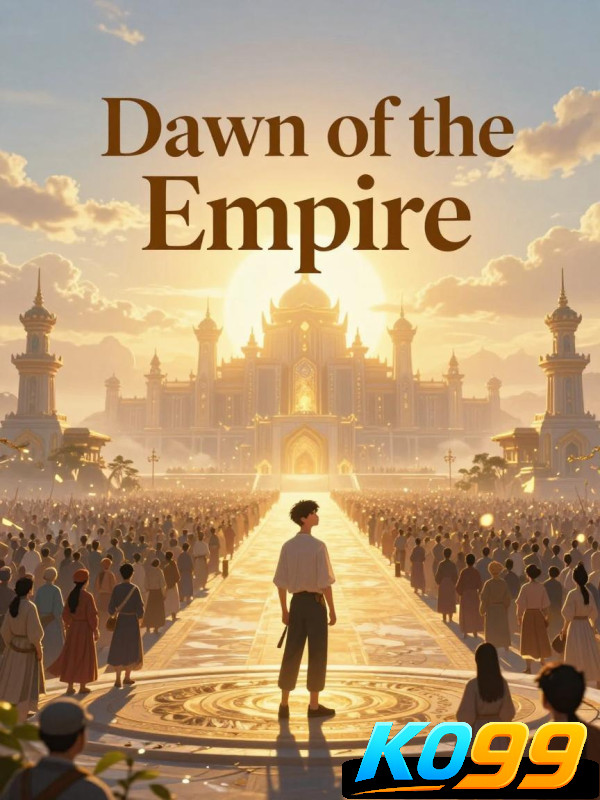
Another dimension, another world. The first rays of dawn from the Eastern Empire of the Never-Setting Sun have just begun to bathe the land. An ordinary young man from Earth joyfully basks in the empire’s morning light, becoming part of the tide of expansion. The sun will forever shine upon the land of China!



Chapter 17: The SF Express Expedition
The return journey was a bit faster than the trip there, though they weren’t traveling at full speed. Along the way, they left behind a few wounded and frail slaves, but recruited several dozen able-bodied men. Like Takurai, these men were all unlucky souls whose tribes had been overrun by the Di-Qiang. They had originally infiltrated the area, hoping to find an opportunity to rescue their own relatives. The morning after the Thousand-Man Corps’ surprise attack on the tribe, they realized the situation had changed. As the main force departed, several veteran hunters had been keeping a close watch; some spotted their own family members being led away, confirming that the attackers had emerged victorious. So they rallied their comrades, and in one fell swoop, over thirty men defected to our side. Huang Qianzong was very pleased with this unexpected windfall; the operation had been a resounding success, and the greatest reward of all—official recognition of his merits—still awaited him. He was grateful to Ou Yang for his initial encouragement and considered the young man a lucky charm. Seeking to win him over, he decided to give Ou Yang the weapons he had originally lent him as a gift, and even waived the bear skins and bear paws that had been agreed upon. Four days later, the main force returned to Anxi Garrison. The townspeople erupted in thunderous cheers; since Anxi’s founding, this expedition had yielded the most bountiful spoils. Managers from major merchant houses in the interior who were stationed in Anxi Garrison also rushed to welcome Huang Qianzong and his party. With the sudden addition of over five hundred slaves—both Chinese and non-Chinese—the small Anxi Garrison would certainly be unable to absorb them all. Recently, the market for slaves in the interior had been booming; buying even a single one promised a profit many times over. However, according to regulations, the commanders could only decide how many to sell after the various units had finished dividing up the spoils; at this point, the ownership of these slaves was still unclear. October 13, Year 30 of the Republic The square where the troops had originally set out was bustling with activity. Today’s main purpose was to distribute the spoils of war among the various units, so the officers were not clad in full armor as they had been at the time of departure. Huang Qianzong, wearing a thick satin-lined cotton jacket with his hands tucked into his sleeves like a wealthy landowner from the interior, sat on the platform with a cheerful smile, watching the boisterous crowd sort the slaves into groups. According to the distribution method in common use in the frontier at that time, the soldiers first divided all the captives into ten roughly equal portions. The highest-ranking local civil official selected one portion (tax revenue), the military officials selected two portions (imperial tribute), and the remainder belonged to the troops that had carried out the campaign. Huang Qianzong could take one additional portion, but only this one was truly his own property. As for the remaining people, Ou Yang had the right to select half from the public share and to divide his private share equally, allowing him to take away more than ninety people—considerably more than what Huang Qianzong received. The group laughed and jostled one another as if they were selecting livestock. Ou Yang’s “Virgin Mary syndrome” flared up once more; unable to bear witness to such a scene, he sent Heheli to select the slaves while he made up an excuse to go and take stock of the other spoils of war. In addition to the captives, he had received nearly a hundred hides this time—mainly sheep and deer skins—all found among the Di and Qiang tribes. His own men had also hunted down some fine goods, though the sable and bear pelts were set aside as gifts and needed to be kept separate; Ou Yang planned to sell the remaining spoils for cash right in town. After this battle, he felt a severe lack of confidence in his own fighting ability. If Heheli hadn’t stayed by his side throughout the fight, the Mad Lion would have easily torn him to pieces. Moreover, lions are supposed to be herd animals—with all this talk of princes and empires, he might not be so lucky the next time he encounters a few. Even with his handgun, his own combat prowess was practically nonexistent; fortunately, he still had several hundred Di Yi slaves who were bound to be loyal to him. Spending money to arm them all would be more beneficial to him than saving it. Ou Yang did some quick calculations in his head. Back in his hometown in Qi Province, a good deerskin was worth five or six yuan, and a warbow cost about one yuan and fifty jiao. At these prices, the proceeds from the furs alone would be enough to arm all eight units of able-bodied men. He could keep the livestock raised by the Di and Qiang for himself—the Di people, who had sheep’s horns, actually relied on mutton as their primary source of meat. Ou Yang felt he still knew far too little about these intelligent races, Zhihui from humans. As for the remaining meat and grains, Ou Yang planned to take them back to the village to distribute among the villagers. Just then, Hu Lanshan approached quietly and reported in a low voice, “Sir, Manager Qin of SF Express has sent someone to invite you to his office for a discussion.” Just what he was thinking about—and here it was. He had just been thinking about how to turn the spoils of war into cash when a merchant came calling. SF Express was a household name throughout the entire empire. Back when the empire fought a decisive battle against the Tatars on the grasslands—as tens of thousands of steppe cavalry charged like wolves and boars—the manager of SF Express had driven a wagon right behind the imperial army, hauling liquor and silver to trade with the frontline soldiers for their spoils of war. SF Express built its fortune on military supply caravans. Today, its business spans the entire North, covering an extremely wide range of areas, yet it has never abandoned its original line of work. Nowadays, along the Empire’s northern border—from the far north’s Haibei Road to the far west’s Lingxi Road—anywhere north of the Yangtze River where frontier garrisons still frequently engage in battle with the Di Yi tribes, SF Express’s presence can be felt. In the interior, it would be considered quite rude for a merchant to simply show up unannounced like this, but Lingxi is a frontier region, so there aren’t as many formalities. Moreover, SF Express is a massive enterprise with excellent relationships with garrisons across the region. A junior officer like Ou Yang naturally wouldn’t make a fuss over such a minor breach of etiquette. Since he was determined to sell his spoils of war to purchase weapons and strengthen his unit’s combat effectiveness, he simply had to meet with the manager of SF Express Trading House. He couldn’t speak for others, but they would certainly be able to procure weapons suitable for the Di Yi tribes. Like all the other trading houses stationed in Anxi Garrison, SF Express’s headquarters was located near the small central square—a two-story building with glazed tiles. This building could be considered the second most luxurious structure in Anxi Garrison—the first being the school. According to the *Great Hua Code*, no building—not even the Governor’s Office—was permitted to exceed the architectural standards of the local official academy, with the exception of the Imperial Palace and the Confucian Temple. No one dared to violate the *Great Hua Code*, even though the total number of teachers and students attending the local official school in Anxi Garrison year-round might not even reach fifty. The ground floor of the SF Express branch was a large hall where more than a dozen people who looked like apprentices sat behind a row of wooden counters, writing and drawing, with the clatter of abacuses ringing out from time to time. Along the entire Lingxi Road, this display was enough to strike fear into anyone’s heart. Even Takurai, who followed behind Ou Yang and wasn’t afraid to kill, felt daunted by the sight. If Ou Yang hadn’t told him to carry a roll of deerskin as a sample, he probably wouldn’t have dared to step inside. To Ou Yang, who came from another world, this spectacle seemed somewhat comical. Anxi Garrison had a small population, and even fewer Han Chinese; aside from when military units returned from hunting expeditions or battles, there was actually very little business to be had. Seeing so many people employed year-round, Ou Yang seriously wondered if SF Express was operating at a loss locally—it was practically a case of “saving face at the expense of suffering.” Like all major trading houses, the second floor of SF Express Trading House consisted of a row of well-soundproofed private rooms, specifically designed for negotiating “big deals.” A pretty young girl who looked to be about fifteen or sixteen, with cat ears and a tail, greeted Ou Yang at the top of the stairs and led him to a room on the east side of the second floor. The non-Han guards at the door stopped Takurai, allowing only Ou Yang and Hu Lanshan to enter the room. Ou Yang didn’t really mind this; he’d only called Takurai over to have him carry the product samples, and there wasn’t really any danger here that would require a guard. “Holy cow!” As soon as Ou Yang entered the room and got a clear look at Manager Qin, a catchphrase from his past life slipped out.