
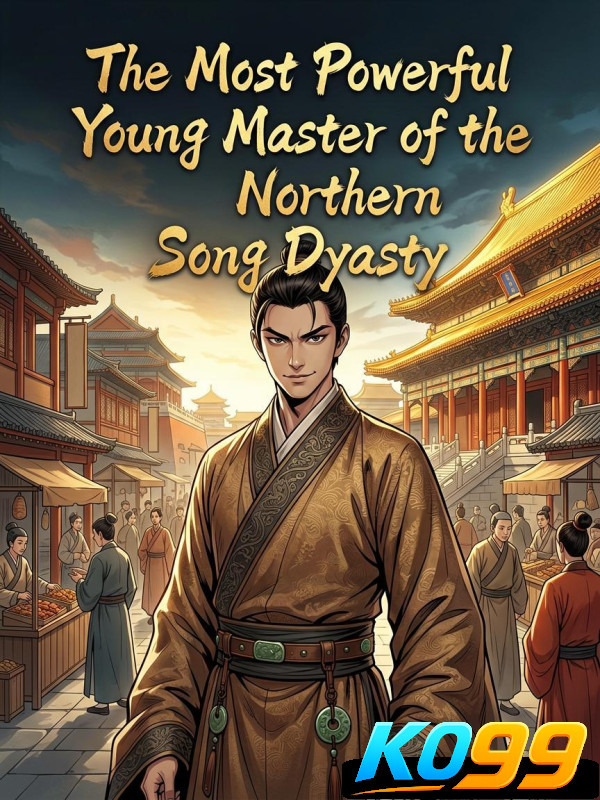
A man with a persecution complex is transported back to the Northern Song Dynasty. He’s been a child prodigy since birth and has a rather domineering father named Wang Anshi. “There are always rogue subjects trying to harm the Emperor.” It’s hard to imagine these words coming from the virtuous and benevolent Emperor Renzong. Yet this was the little scheming minister instigating the Emperor. “Don’t let my young age fool you.” After a bit of reckless mischief, the young master managed to bring down many powerful figures. “I’ve been bitten, I’ve knelt, I’ve bowed my head—that’s why I’m glorious.” Many years later, the Song Dynasty—a nation capable of both flexibility and firmness—received congratulations from all directions, with barbarian tribes from every corner of the world paying homage. But the young master felt it still wasn’t sleazy enough; the world still needed to be tamed…



Chapter 36: A Vision of “Everyone Eats Chicken”
“We’ve won. Di Qing led a surprise attack with 1,300 elite cavalry, securing a great victory at Kunlun Pass. The rebel leader Huang Shimi was killed in action, and Nong Jianzhong was captured alive! As of the release of this military report, Di Qing’s forces have continued their advance toward Yongzhou!” Even in the streets of Shuzhou, gossipmongers were rushing excitedly to spread the news of the victory. So, at least during this rather dreary time, some good news had finally arrived. The entire Song Dynasty would be invigorated by it. Di Qing truly had the tenacity of a turtle. Since he’d already secured a great victory at Kunlun Pass, a triumph at Guirenpu couldn’t be far behind—it was time to deliver the final blow to his useless teammate, Chen Shu. So Da Bang scampered into his rogue father’s study and said, “Father, it’s time to write a letter to Chancellor Zhang Fangping. Have Old Zhang step in and immediately drag Chen Shu to the Capital City to ‘flog his corpse.’ ” Wang Anshi frowned deeply, clearly displeased with the boy’s tone, but asked curiously, “Why is that? Chen Shu has already been put in the stocks by me—how much more can you possibly do to him?” Wang Bang chuckled darkly and said, “Out of sheer arrogance, he disobeyed military orders and cost the Great Song the lives of eight thousand soldiers. To be honest, no amount of punishment would be too much for this blockhead. Weren’t those fallen soldiers also born of human parents? Am I wrong?” “You…” Wang Anshi thought it over carefully, however, and realized the young man had a point. After the defeat at Haoshui River all those years ago, the scene left behind by the soldiers who had fallen—their wives, children, and elderly relatives—was truly overwhelming. They had gathered together, weeping uncontrollably. Faced with that sight, Han Qi had been so distraught that he coughed up half a mouthful of blood, and a fifth of his hair had turned white overnight. As for Chen Shu, when Wang Anshi arrived, he acted as if nothing had happened—in fact, he seemed to be waiting specifically for Di Qing to start a confrontation, ready to argue over who was right or wrong and shift the blame. That’s why Wang Anshi flew into such a rage at the time; beating up Chen Shu then may not have been instigated by Wang Bang after all. Thinking about it this way, Wang Anshi realized that this little devil wasn’t entirely wrong after all. “Explain that in detail,” Wang Anshi said, feigning interest and listening intently. Wang Bang spoke eloquently: “With the great victory at Kunlun Pass, Di Qing will never lose again; it’s just a matter of going through the motions to secure the victory. Because Chen Shu suffered defeat at Kunlun Pass—and the sons of the Great Song died there—that place has become a curse, a psychological shackle, and a key factor affecting military morale and cohesion. This is why Di Qing did not deploy his main force, but instead launched a surprise attack with just 1,300 elite cavalry. Now that we’ve regained our footing at Kunlun Pass, the Song army’s morale and fighting spirit have largely returned, so tactically, Di Qing should be in a stable position. But the problem is this: now that Di Qing has won the war, his bloodlust has subsided, and he won’t actively seek to kill Chen Shu—yet Chen Shu may not stay put.” Wang Anshi paused for a moment and said, “Go on.” Wang Bang continued, “The more resoundingly Di Qing wins at Kunlun Pass, the more incompetent Chen Shu—who suffered defeat there—will appear. Add to that the fact that he was soundly beaten by you, Father, and that no one is speaking up for him, and Chen Shu will become even more enraged and likely resort to extreme measures. So I wouldn’t go so far as to say he’ll deliberately hinder Di Qing’s advance on Yongzhou, but if Chen Shu—with his resentment now building up again—takes the initiative to confront Di Qing, and given that Di Qing is a hot-headed and impulsive man, there’s no guarantee he won’t be reminded of Chen Shu’s incompetence and past actions. Therefore, there’s still a risk.” Wang Anshi said, “Bang’er, you’re overthinking this. Chen Shu may have the nerve to do it, but now that victory in the war is certain, I’ve already warned Di Qing and helped him vent his anger. Nothing major will come of it. As for verbal spats and petty disputes, we can’t control every little thing.” “Father, you’re mistaken,” Wang Bang said. “That the war is a sure victory is merely my assessment, not Di Qing’s. Di Qing is certainly on edge—his own life, his brother’s life, and the hopes of his brother’s family all weigh heavily on him. As he advances on Yongzhou right now, he’s still walking on thin ice; there’s no room for even the slightest misstep. Di Qing will value the military morale and cohesion that have been so painstakingly built up more than his own life—this is the mindset a military commander must possess. Given that, once Chen Shu has partially recovered from his injuries and is able to move again, if that old rascal runs to the front lines to pick a fight with Di Qing, I’m certain that no matter how much Di Qing might not want to kill him, he’ll have no choice but to do so.” Wang Anshi’s face paled as he stood up and said, “Are you suggesting that Chen Shu will act recklessly, and that Di Qing, in order to prevent ‘internal discord from undermining morale,’ will still kill Chen Shu?” Wang Bang spread his hands and said, “Nothing is absolute, but I believe it’s highly likely. If it were me, I’d kill Chen Shu as well. If, before the decisive battle, the officers were to witness the high-handedness and arrogance of the literati—and see that the commander-in-chief has no authority—what would the army think? It would be a miracle if we could even continue fighting.” Wang Anshi thought for a moment and smiled wryly. “How would you like your father to respond to Minister Zhang Fangping?” “There’s no need to beat around the bush—just use my exact words. Zhang Fangping may not have the authority to recall Chen Shu to the capital for a report, but Pang Ji does. Old Zhang has ways of handling the situation. Di Qing’s deployment was recommended by Pang Ji; if Di Qing suffers a defeat in the Yongzhou campaign, it will be Pang Ji who loses the most face. So no matter how despicable Pang Ji may be, as long as Zhang Fangping explains the consequences to him, Pang Ji—even if it stirs up resentment—will inevitably recall Chen Shu to the capital to beat a dead horse.” Wang Anshi sighed and, as he picked up his brush to write a letter, remarked, “It seems this Chen Shu is truly going to be driven to his death by us.” Wang Bang replied nonchalantly, “Let him die if he wants to. That’s just the nature of war and politics. It’s not his first day in office, and he’s certainly not a novice when it comes to understanding these realities.” Wang Anshi slammed his brush down on the table and said irritably, “You’re right, but I won’t stand for you acting so callous. We haven’t done anything wrong, but it’s not exactly honorable either—we can’t treat this sort of thing as if it were a matter of course.” Ugh, Wang Bang was deeply frustrated. His dad’s biggest flaw was that he wasn’t scheming enough—which meant he was bound to get his head bashed in down the road. However, he could only daydream about it; on the surface, he had to pretend to be a model son. Otherwise, his butt would still be aching right now—he’d have to walk like a crab and sleep face-down. Last time, Old Liao had really beaten him up—he hadn’t gone easy on him at all. Seeing the young “Shadow Emperor” with tears welling in his eyes, Wang Anshi’s heart softened once more. As he picked up his pen to write again, he said in a gentle voice, “I was a bit too strict. But Yang’er, these are my true feelings, and they’re also why Sima Guang worries about you. You don’t seem to be in the wrong, but you make people afraid—that’s the problem.” After being thoroughly lectured by his strict father, Wang Bang finally shuffled out, still walking like a crab. Who knows when his butt will ever heal… Old Liao was now plagued by pangs of conscience; he felt terribly guilty about having knocked the little brat to the ground. So, during this period, he pretended to be loyal and followed Wang Bang around, working tirelessly like a beast of burden. Every day, Wang Bang rode on his back, steering Old Liao—who moved like a bulldozer—to chop wood. “A Single Sword to Slash the Green Mountains” truly lived up to its name. With a thunderous swing of his greatsword, he saved the carpenters the trouble, neatly cutting down plenty of the timber Wang Bang needed. It was also around this time that the large iron box, which had been sent earlier to Old Zhang’s blacksmith shop in the south of the city to be forged, was finally ready. Xiaobao was still too young to carry heavy loads, so they sent Old Liao to carry the iron box back. This saved them five copper coins in delivery fees—a very cost-effective solution. After that, Old Liao and Erya spent the whole day watching Wang Bang tinker away as he built an incubator. Indeed, based on Erya’s records and care over this period, that small group of chickens—which refused to lay eggs and did nothing but eat—had been roasted and eaten by the “Little Demon King.” Although the remaining chickens were still far from being productive layers, they were already among the best of this batch. So this was the culled generation. When their offspring hatch and undergo careful selection once again, they’ll become the Bronze Generation. The next generation after the Bronze Generation, after further selection, will be the Silver Generation. Eventually, this will evolve into the Gold Generation. By then, these hens won’t lay eggs based on their mood; they’ll treat it as a mission, working tirelessly until their last breath. As long as they’re well-nourished, they’ll lay an egg every day. However, relying on the hens themselves to incubate their chicks is a process that depends heavily on luck—it’s highly unpredictable, slow, and inefficient. Of course, a hen knows her own eggs best, so the hatch rate is indeed much higher when she incubates them herself. However, a single hen has only so many “backsides,” making it difficult to effectively care for multiple fertilized eggs. This is where industrial processes come in to help the mother hen accelerate the process. This is where incubators come in. Without incubators, both hatching and egg-laying would be extremely inefficient and heavily dependent on luck—which is why chickens were so precious in ancient times. They were so precious that chicken soup was used as medicine, and so precious that when Shi Qian of the Liangshan outlaws later stole and ate a young rooster from Zhu’s Village, it sparked a bloody massacre there. Whether the people of the Song Dynasty will one day be able to “eat chicken” on a nationwide scale depends on Wang Bang’s ingenuity right now. The advantage of having a solid foundation is that even without traveling through time with an encyclopedia in hand, one can rely on trial and error—adjusting as they go—to create an incubator suited to the Song Dynasty. Conversely, even if one were to travel through time with an electric incubator and a complete set of instructions, it wouldn’t be of much use; there would still be many difficulties and variables to contend with. Without a solid foundation, there’s no margin for error; the slightest deviation or mismatch in conditions would spell disaster, leaving one completely lost. It’s exactly like this: if you confiscate Old Liao’s sword—even though he’s a Sword Saint—his combat power would drop to about 60–70 percent of his usual level. But if you take away a geek’s Jedi lightsaber, he’d truly become a complete weakling.